Blended capital: a new investment model for defence innovation
Andriy Dovbenko

Traditional venture capital models don’t work for defence. While the full-scale invasion of Ukraine, a grim three years ago, has drastically shifted investor (and public) perception of funding defencetech from “taboo” to necessity, this is still not enough. New funds, such as D3, the Nato Innovation Fund, Archangel, Expeditions Fund and Twin Track Ventures, have emerged and highlighted the step change in investor appetite.
These firms are doing crucial work, backing innovation across the defencetech sector. However, some challenges still remain within the industry. The timelines are too long, the customer base is too small, and the risks are too high.
Central Europe Stirring Special Report
Many geopolitical commentators expect a peace deal to be signed to end the Ukraine war in 2025, leading to a $1tn infrastructure rebuilding programme and investment opportunities. There are also several countries in the region which have matured from frontier bets to core portfolio positions, including Poland and Romania. Our special report takes a look
Yet relying solely on government procurement is too slow for today’s evolving battlefield realities. Despite the UK government’s new £250m ($335m) defence industrial strategy and the fact that it pledged its most significant sustained increase in defence spending since the cold war, this does not even begin to scratch the surface of what is needed. Not only is Ukraine at war, but the sanctity of future European peace is precarious at best.
Relying solely on government procurement is too slow for today’s evolving battlefield realities
Late last year, unknown drones flew over UK airbases, and more recently, there has been a slew of cyber attacks across Europe, not to mention Russian drones being shot down in Polish airspace. These concrete examples show the growing threats — or at the very least, highlight the chinks in our national security armour — that we face.
Traditional venture capital strategies will not adequately address the problem, as western European countries can’t compare with the three countries with the highest military spending globally, the US, China and Russia, respectively. We need another form of defencetech investment, and we need it quickly.
Blended capital
The answer is blended capital. This newly emerging financial architecture combines state-backed funds, private equity, multilateral institutions, family offices, private banks and foundations, and philanthropic capital to achieve a common goal. By utilising all of these available resources, we can unlock the scale and speed needed for defence innovation.
Blended capital de-risks projects and opens access to new markets, which makes the endeavours more attractive to investors seeking market-rate returns. Fostering a symbiotic relationship, where one party is not more important than the other, but rather all are crucially necessary, can overcome the aforementioned hurdles around production and procurement. Unsurprisingly, fast innovation saves lives. This requires large amounts of capital and readily open channels that take something from an idea to tangible technology for military use.
Our attention should turn to funding battle-proven technology that has been forged in the fire of actual warfare. And there is no better “testing ground” in the world right now than Ukraine
It should go without saying that speed does not negate the need for this technology to be effective. Pumping millions (or even billions) into useless technology that has no real use or impact on the battlefield is a gross mismanagement of funds. More than the inevitable waste of money this would be, is the sheer loss of human life. That is why our attention should turn to funding battle-proven technology that has been forged in the fire of actual warfare. And there is no better “testing ground” in the world right now than Ukraine.
Let’s look to Ukraine
Ukraine, with its urgent needs and proven solutions, is the ultimate test case. By building a framework where governments de-risk, investors scale, and innovators retain upside, Ukraine can pioneer a capital model that not only powers its survival but redefines how the West funds defence innovation in the 21st century.
Civilians in Ukraine’s largest cities have faced swarms of drones targeting them indiscriminately. It is not troops or tanks doing the most damage, but anonymous pilots 30km away from their targets and algorithmically programmed machines. So, how do we stop this? One of the only ways to stop them is known as ‘electronic warfare’ (EW), jamming the signals at a protocol level to neutralise them.
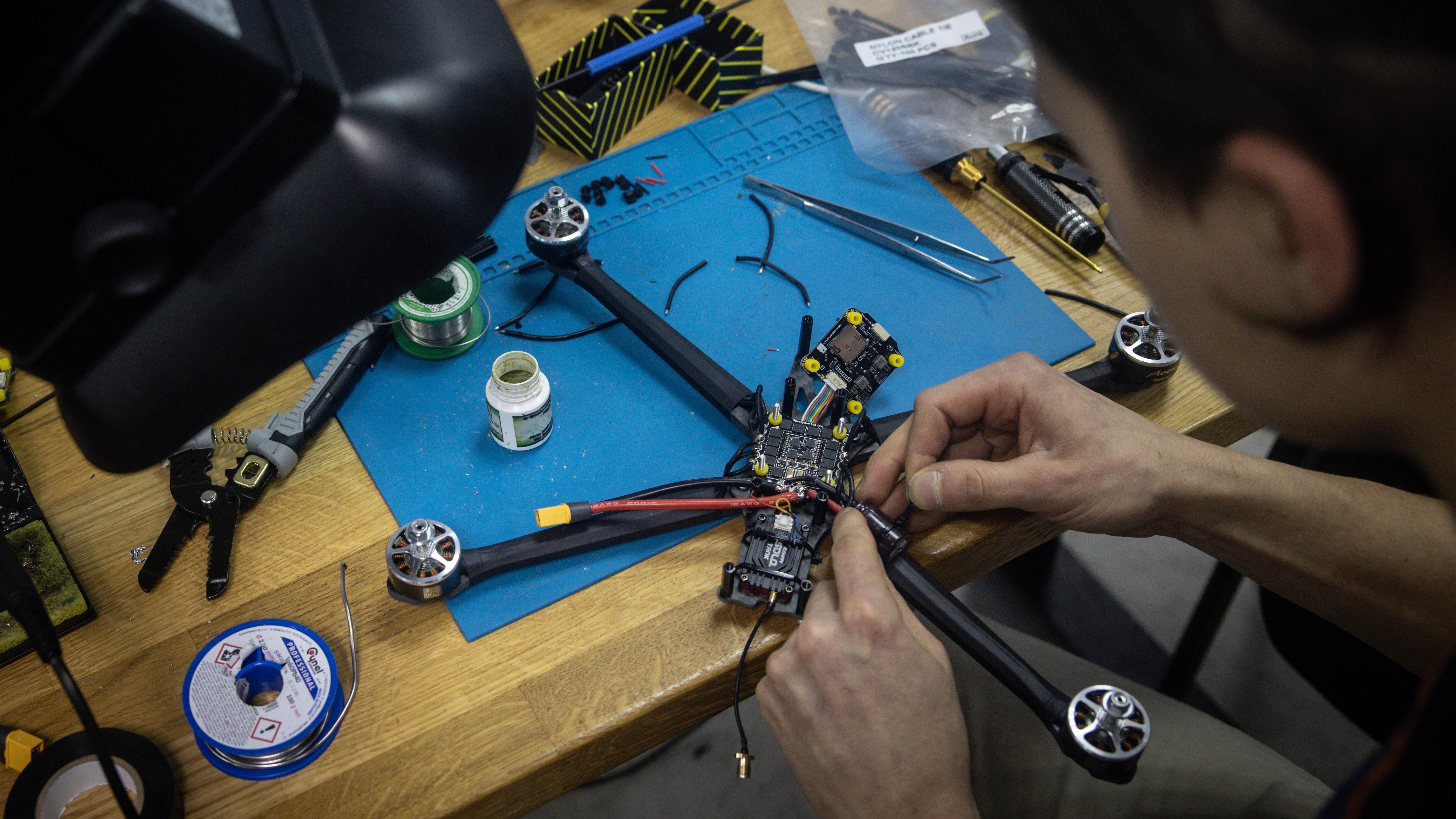
One such company harnessing the power of blended capital is Kvertus, a Ukrainian developer and manufacturer of anti-drone systems for military use, engineered and battle-proven in high-intensity conflict. The EW company supplies the armed forces, intelligence services, and law enforcement of Ukraine. To date, the technology has helped to save more than 100,000 lives since the Russian invasion.
Take Project Atlas, the anti-drone defence initiative developed by Kvertus. Designed as a 1,300 km electronic warfare “wall” across the Ukrainian frontline, it will require more than £100m to deploy.
Kvertus has already committed more than £10m of its own capital into the research and development of this unparalleled technology. In addition, private Ukrainian businesses have contributed around £13m, given largely as donations, as is common in Ukraine’s wartime context. This demonstrates the depth of national commitment, but it is not sufficient to meet the full capital expenditure required.
To close this gap, there is a unique opening for foreign investors and private capital. Project Atlas is more than a Ukrainian defence programme; backed by the Armed Forces and the government’s Brave1 platform, it is a blueprint for Nato countries bordering Russia and a signal of how allied nations will safeguard their security in the years ahead.
This is where blended capital becomes critical: combining government backing with private equity, family offices and philanthropic funds accelerates deployment, de-risks the investment, and allows investors to be part of a project that is both strategically vital and financially compelling.
The moral and financial returns
Times of war don’t just reveal who is fighting; they also expose how prepared the world is to help. With this kind of warfare, investment must evolve as the technology does, or it risks becoming irrelevant. Policies and financial models that limit life-saving innovation are not only outdated but dangerous. It’s time for blended capital to step up and speak out.
The combination of impact investment and philanthropy has both moral and financial returns. It permits such banks and foundations to generate returns from infrastructure and technology investments within their alternative assets allocation bucket. When state funds, private equity, family offices, private banks and foundations, and philanthropic organisations work together, wars can be ended and lives can be saved.

Andriy Dovbenko, founder and principal, UK-Ukraine TechExchange