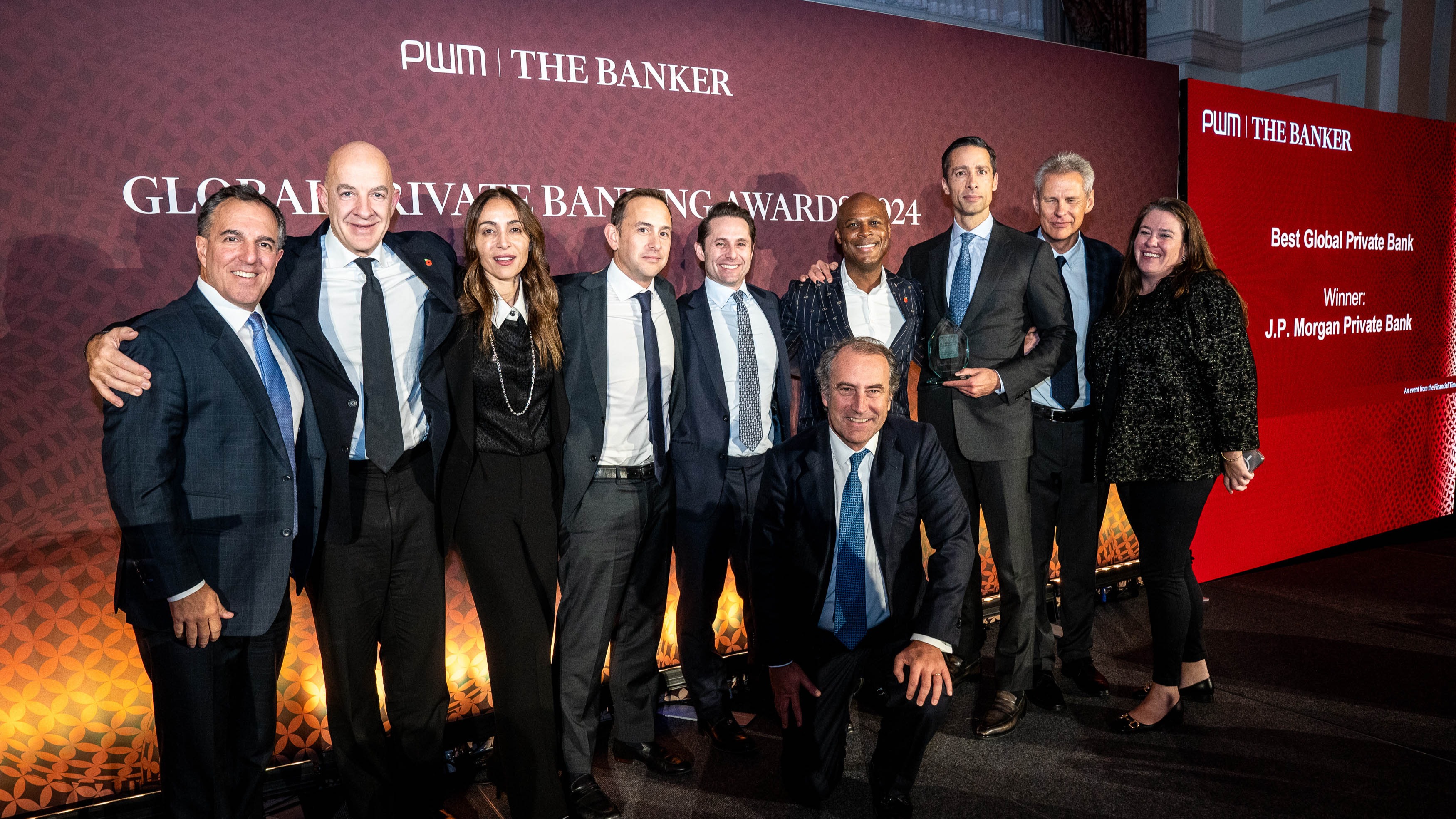
Global Private Banking Awards 2024: Taking the pulse of private banking
By Yuri Bender

Many of the biggest private banks are doubling down in key markets while mid-sized firms are trying to differentiate themselves from peers.
The results of the Global Private Banking Awards for 2024 – presented by FT titles PWM and The Banker – serve as an excellent barometer of key industry trends.
Firstly, we have seen a changing of the guard, with a troubled Citi now eclipsed by a resurgent J.P. Morgan Private Bank, when we assess global players of US origin. The other “Masters of the Universe”, including HSBC and UBS, are increasingly doubling down in their key markets.
Secondly, we have seen mid-size firms trying to differentiate themselves from the competition, focusing on specific client segments, investment specialisms and adviser training programmes.
Further reading
Lastly, there is a revival in boutique firms, as family offices and wealthy clients realise commoditised service and products provided by the biggest players are not necessarily contributing to financial well-being.
Whereas leaders including Citi and UBS have experienced structural challenges, J.P. Morgan has been carried by strong branding, both in its domestic US markets and abroad.
It enjoys a solid balance sheet, avoiding the need for risk-taking and experiments, which sometimes leave rivals floundering. But questions are also being asked about innovation at the bank, especially in foreign markets.
“J.P. Morgan is making good progress globally and its brand and name recognition certainly help,” says Kim Cornwall, visiting lecturer in wealth management and derivatives at Warwick Business School in the UK, formerly director of private banking at SG Hambros.
“It is a well-managed behemoth and deserves its success. The problem is once you are at the top, there is only one way to go.”
Our judges believe that in a difficult environment, it is the bank steering the truest course, keeping errors to a minimum.
“J.P. Morgan has been building its footprint and penetrating the seriously high net worth segments in a very focused manner,” believes branding expert Anant Deboor, head of strategy at Wunderman Thompson in Hong Kong. “Citi’s problems and UBS’s integration challenges have only aided its progress.”
But its major strength – reliance on a currently booming US economy which may soon face major political challenges, may also prove to be its Achilles heel. J.P. Morgan has always failed to encourage expansion in Asia, seen by many as the world’s growth engine.
Asian battle of the behemoths
Asia, say observers, is where the true Champions League of private banking will be played out. The battle of the behemoths, where UBS and HSBC are fighting tooth and nail for Asian supremacy is intense, if finely balanced. Both are now investing in Singapore as well as Hong Kong, showing a dual focus on growing southern economies, particularly India and Indonesia, with an eye on the main northern prize of Greater China.
“HSBC cannot afford to lose in Asia and will pull out all the stops,” believes Mr Deboor. “It was about to claim the number one spot, just before the UBS takeover of Credit Suisse clients and AuM, so that is certainly its way to go.”
HSBC is renewing its focus on Asian high net worth and ultra-high net worth client segments through new marketing initiatives. UBS’s move into West Kowloon, where it will be part of the railway hub connecting Hong Kong to Shenzhen, is also seen as a major investment in mainland business.
“This battle will only intensify,” he predicts. Fuelling the next stage of the rivalry will be an expected bounce back from China as source of client business for regional banks, bearing in mind this is the 75th anniversary year of the Chinese Communist party, and the political leadership cannot afford to let the economy slide.
Room at the top
Indeed there will likely be room for both behemoths in this vibrant marketplace. “In the longer term, both will have a role,” believes Ray Soudah, founder of Zurich-based strategic consultancy MilleniumAssociates.
“HSBC has a more holistic service offering, wider than just asset management, which is the main focus of UBS as an asset gatherer,” he says.
In the tier below these giant firms, there is increasing space for specialists to target more niche if still major client segments.
One key target, unsurprisingly, are entrepreneurs, which few cross-border players have been able to serve successfully, despite grandiose claims of expertise in this burgeoning area.
Currently, entrepreneurs are being successfully harvested by the likes of Deutsche Bank, BNP Paribas and Northern Trust, although their experiences have been mixed against a challenging backdrop.
“Such institutions perceive an opportunity, especially because their commercial banking divisions have lost market share to credit funds and the strength of equity markets,” says Mr Soudah.
“It’s unlikely to make much difference overall and private banks are littered with accidents, whenever they move away from simple straightforward asset management services,” he warns.
But others are less cynical, believing this to be a major trend developing, for those banks with the right structure, capacity and mentality to succeed in this important segment.
“Entrepreneurs are ultra-demanding. When they invest in plant and machinery in their own businesses, they target an absolute return. That sets a benchmark for their portfolio investments,” comments Amin Rajan, CEO of the CREATE-Research asset and wealth management consultancy.
“They are loss averse and have zero tolerance for mediocrity and relative returns. They believe active managers should have the skills to survive and thrive in bad times, just like good ordinary businesses do.”
In fact, for most clients, investment performance, determined by excellence of chief investment officers at regional champions including Asia’s Bank of Singapore, Latin America’s LarrainVial and Europe’s Unicredit, is the main attraction for potential clients, believes Mr Rajan.
Portfolio performance
“Investment returns matter far more than clients would care to admit publicly,” he claims. “Clients would be tolerant of poor service, if returns are great. But they would ditch a manager if the service is great and returns are mediocre. Good service cannot buy groceries.”
The opposing view, from Sharmil Patwa, founder of the Opus Una tech transformation consultancy and former director at Barclays Wealth, is that clients require a more holistic approach, well beyond portfolio performance. Few banks are able, however, to offer this with any real quality or conviction.
“We need a true ‘one bank’ model,” he says, commenting on the ill-fated structure propagated by Credit Suisse, which contributed to the bank’s collapse, as poor decisions in investment banking ended up triggering outflows from the wealth management division.
“Unfortunately, that is generally only a possibility for the larger banks,” encumbered with organisational culture and incentive structures that do not encourage a client-focused approach.
Sweating the assets
“Entrepreneurs are already running enough risk on their businesses,” says Mr Patwa. “They’re generally less interested in a slight improvement in performance in their portfolios, and more interested in how they can ‘sweat’ their personal non-cash assets and in well-structured solutions.”
With larger players often incapable of correctly identifying or implementing technologies to offer a “bespoke user journey” at scale, the more niche players such as Fifth Third Bank in North America and Africa’s Investec franchise are increasingly standing out for their customer service proficiency. The biggest players often seem almost fatefully confined to a limited, industrial approach to product creation and client relations.
A major opportunity for smaller, boutique players is therefore opening up, believes Nicole Curti, CEO of the Alliance of Swiss Wealth Managers and managing partner at the Capital Y boutique in Geneva.
“This creates the perfect storm for serious, large and well-structured players that are independent wealth managers of a certain size, managing at least $1bn,” says Ms Curti, formerly with Lombard Odier and family office Stanhope Capital.
“Those players have the best of both worlds: on the one hand flexibility to act swiftly, to ensure a personalised service. They are not involved in product pushing – like banks have to do – while prioritising long-term engagement with private clients, with no pressure on margins,” she says.
“On the other hand, they are fully licenced, regulated companies, which in terms of standards come very close to what banks are, giving private clients a lot of comfort and reassurance.”
An increasing failure of the largest players to satisfy a demanding clientele could likely boost this sector’s attraction even further. “Scale is the enemy of service as well as alpha,” says CREATE’s Mr Rajan.
“Scale has led to client segmentation, which means only those in gold or platinum categories for the ultra-rich get premier service. The majority have to endure a service proposition that looks more and more commoditised.”