Global Private Banking Awards 2025: Private banking health check
Yuri Bender

When industrial families, corporations and wealthy investors seek a private bank to look after their financial needs, what sort of operator are they looking for?
A recent shift in mindset is showing us that culture, leadership and service model are increasingly pulling ahead of investment expertise and digital prowess when it comes to selection criteria.
Representatives of large families, former senior bankers and industry consultants are united in highlighting the growing importance of cultural components, in an industry where they feel investment expertise and tech stacks are becoming increasingly commoditised.
The brand promise and its eventual delivery are clearly two very different elements for private banks — something the judges of PWM’s Global Private Banking Awards for 2025 are keenly aware of.
The right fit
One of the key decisions that potential clients are making — when deciding how to allocate assets between a handful of their favoured banks — is whether to favour the behemoths, the boutiques or something in between.
There is a notion emerging that clients who have long felt “boxed into choosing from a select few large size service providers” are tired of being treated merely as a “number”, says a partner in a leading European family office. This realisation coincides with a major enhancement in the service offering of mid-size players, who were spurred by the Covid-19 pandemic to focus more on succession planning and legacy, within a broader menu.
Further reading
Regional champions appear to be enjoying something of a renaissance in this regard, especially with less emphasis in different continents on globalisation.
“I think there’s much scope for regional players. Indeed, many clients often prefer this,” says Charlotte Thorne, founding partner at the Capital Generation Partners multi-family office in London.
“They might initially be attracted by the global brands but then are often surprised to discover the banks are not integrated across regions.”
This was a common complaint among our judges when choosing a leading player able to service families globally. Citi was one of the few banks they felt fulfilled these criteria.
“It’s not uncommon for a US or UK client to be frustrated that they cannot access a ‘one bank’ solution, but have to be served separately in each region, with all the complexity that entails,” adds Ms Thorne.
Segmentation initiatives by some leading banks are even starting to alienate potential clients. “It’s baffling for clients when one minute they are served by the private client team and the next minute by the external asset managers (EAM) team,” she says. “This can happen particularly to family offices, who are viewed differently by different parts of the bank.”
A number of rising names have burst onto the scene during the past two years. Some have been around for a time, but their abilities appear to be gaining increasing resonance across markets. These include Axis in India, EFG and Brown Shipley in the UK, and FNB in Africa.
“Up and coming players have a different offer,” she suggests, providing a more tailored service which chimes better with many multi-banked clients.
Swiss surge
A major consolidation of banks — including the UBS takeover of Credit Suisse — has opened the door to players that can provide a more personalised service for clients, who often search in vain for “the right person to offer tailored advice”, believes Nicole Curti, CEO of Geneva-based boutique Capital Y, pointing to a “very interesting surge” of 120 new independent wealth management firms springing up in Switzerland since the end of 2023. “That shows a very dynamic market in serving clients,” she says.
In order to differentiate themselves, banks need to be thinking about more than gathering assets and providing “generic wealth management”, says Elizabeth Hart, founder of Legacy Wealth Advisors in Singapore, whose career has included spells with LGT and Rothschild & Co.
“By broadening out their services to cater for particular segments like women’s wealth, succession planning, philanthropy and entrepreneurs, firms have the opportunity to deepen client relationships and tailor their services to meet the increasingly complex needs of wealthy clients,” she says.
External advisers — be they boutique wealth management firms or family offices, often staffed by high-profile refugees from the major banks — are positioning themselves as “disruptors” to traditional private banking business, and their strength is growing.
By broadening out their services to cater for particular segments like women’s wealth, succession planning, philanthropy and entrepreneurs, firms have the opportunity to deepen client relationships and tailor their services to meet the increasingly complex needs of wealthy clients
“Forward-looking banks are embracing this trend and building out specialist EAM desks,” she says, “to improve client retention and increase partnership with external advisers.”
Accident-prone industry
In reality, all large banks have had their share of problems in what is an “accident-prone” industry, believes Shelby du Pasquier, head of the banking and finance group at Geneva law firm Lenz & Staehelin, a leading practitioner who represented Swiss banks in their dispute and eventual settlement with US authorities in 2009.
“Good governance and tight controls will allow a bank to limit the occurrence of problems, and their seriousness, but will not eliminate them,” he suggests.
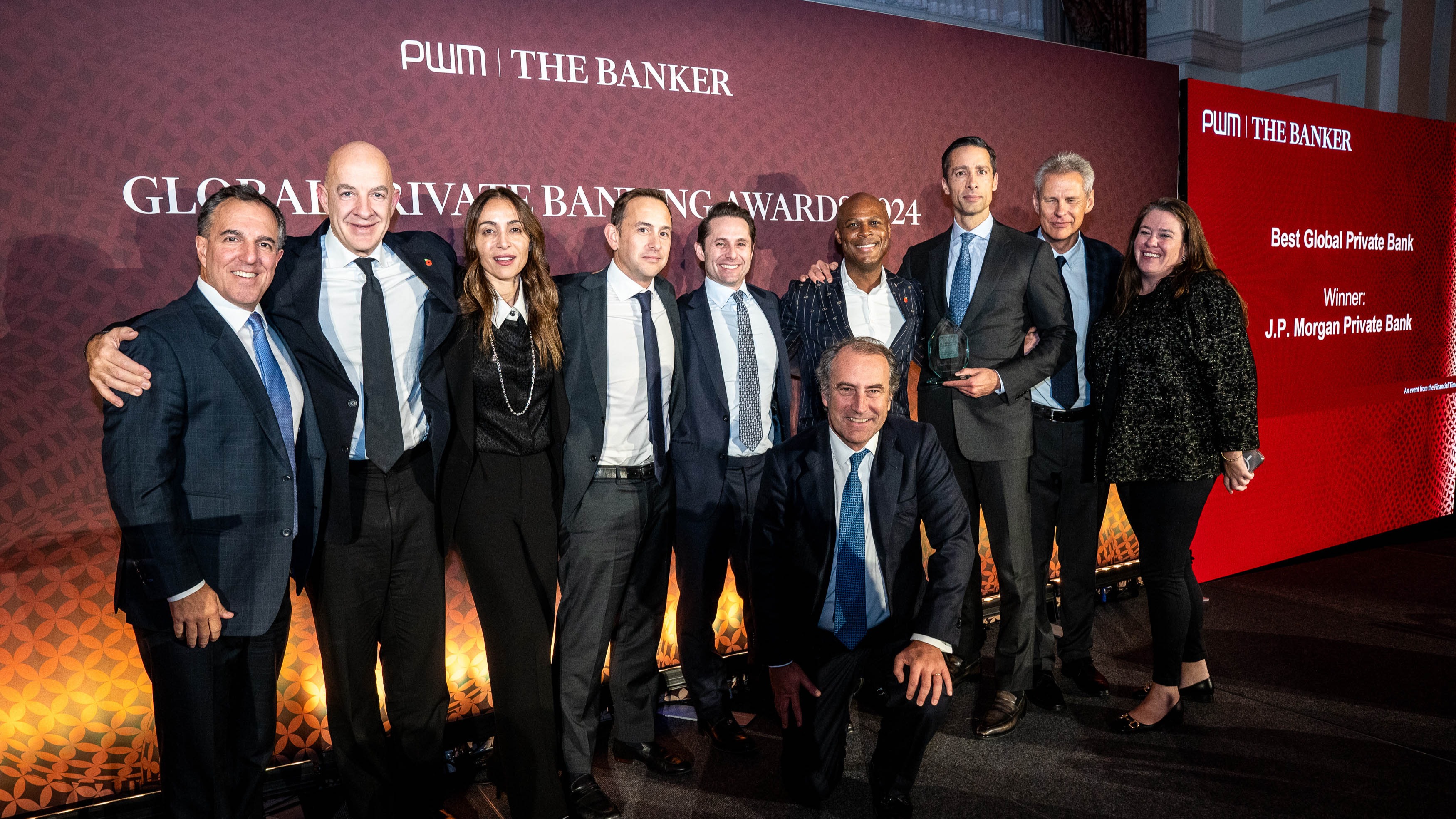
There is broad agreement that although UBS, J.P. Morgan and Citi all remain at the helm of the industry, it is J.P. Morgan which has recently enjoyed a “peaceful stretch after some patchy years”. But its cultural reorientation is also highlighted by those who know the bank well.
“The firm manages to make a big place feel small for its employees,” says Munich-based Matthias Schulthess, co-founder of financial services search firm SZ & J, previously a senior banker with UBS in Hong Kong.
“It achieves a rare balance between scale and a strong sense of belonging. The visible presence of group CEO Jamie Dimon meeting key clients across different geographies sets the tone for the whole organisation,” he says, “creating an environment that values accessibility and accountability.”
This culture, based around leadership and understanding the mechanisms of private banking is key to J.P. Morgan’s success, says Sally Tennant, founder of Acorn Capital Advisers and former private banking boss at Kleinwort Benson and Schroders. “Theirs is a trust business first, and product second. They act global but feel local in culture.”
But these behemoths are also faced with major challenges, believes Malik Sarwar, a former senior banker with Citi and HSBC who now runs the wealth management practice at the Global Leader consultancy in New York.
“J.P. Morgan may be strong and successful, but their key risk is over-dependence on one man, who is now bordering on hubris,” he says.
Predicting growing success of regional players such as DBS in Asia, Northern Trust in the US and Coutts in the UK, Mr Sarwar however points out a growing disparity in their fortunes, compared to those of the giants.
“The regionals have a strong home base, but it’s best for them to stick to it,” he says. “As soon as they go beyond, the competition makes it too difficult for them to scale profitably. Even HSBC struggles outside of Asia and the Middle East and north Africa.”
For private banks and wealth managers globally, the ecosystem is clearly becoming one governed by more complex dynamics. But for now, at least, culture is king.